
The Challenge of Photographing Fabric
How do you show something that is meant to be touched?
Photographing fabric sounds simple. Lay it out, light it well, take the picture. But textiles are unusually difficult to translate onto a screen. A photograph can show colour, pattern and shape, while the qualities that often matter most, such as softness, weight, drape, thickness and texture, are understood through touch. For a textile brand, that creates a particular challenge: communicating a material experience through a flat, visual medium.
Texture and the Camera

Texture is one of the first things a camera can flatten. A weave that feels pronounced in the hand may look almost smooth in a wide shot. Fine loops in terry, the depth of a waffle weave or the irregularity of a slub can disappear unless the light catches them at the right angle. Close-ups help reveal the structure, but even then they can only show texture. They cannot tell you whether something feels crisp, soft, dense or airy. Those qualities have to be communicated through other visual clues.
Light plays an important role here. Light falling directly onto a textile can make the surface appear flatter, while light coming from the side creates small shadows between loops, folds and yarns, making the construction easier to see. Woven colour introduces another variable, as different threads can catch the light differently. Photographing a textile therefore involves deciding which of these material characteristics need to come through in the image.
The Difficulty of Getting Colour Right

Colour presents a different problem. A textile can appear one way in daylight and quite another under warm indoor lighting. The camera interprets the colour through its own settings, the photograph may then be edited, and finally the image is viewed on a phone or computer with its own screen brightness and colour settings.
By the time someone sees a product photograph online, its colour has passed through several layers of interpretation. This is why accuracy becomes particularly important in textile photography. The aim is to keep the photograph as close as possible to the fabric itself, while recognising that a colour seen on a screen can never be completely identical to one seen in person.
Showing Scale and Proportion

Scale can be surprisingly difficult to communicate too. A pattern that appears delicate in a close shot may feel much larger when spread across an entire bed. A towel photographed by itself offers few clues about its dimensions, while a weave that appears prominent in a macro photograph might barely register when viewed from across a room.
This is why textiles benefit from being photographed at different distances. A close view can reveal the weave and construction, a wider photograph shows the complete pattern and its proportions, and an image within a room gives the viewer a better understanding of scale. Together, these perspectives build a more complete picture of the textile than any single photograph can.
What Folds Can Tell Us

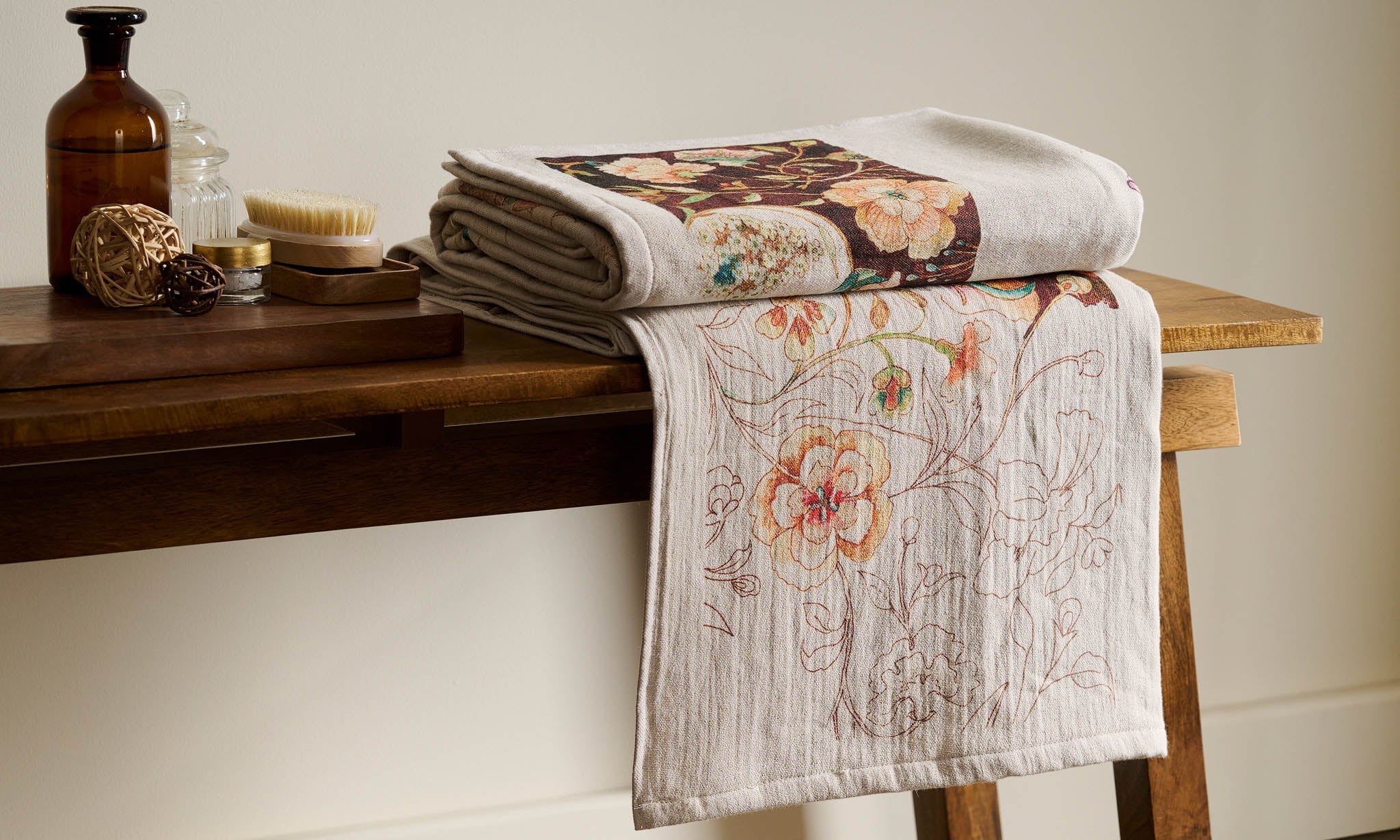
Folds may look like styling, but they also convey useful information. A softer fabric collapses differently from one with more structure. Heavier textiles create deeper folds, while lighter fabrics tend to gather more easily. The way a bed cover falls over the side of a mattress or a towel hangs from a rail can therefore offer clues about weight, movement and drape.
Some fabrics present very specific photographic challenges. Fine stripes and tightly repeated weaves can create moiré, a visual distortion caused by the interaction between the pattern and the camera sensor. Dark colours can lose surface detail, while very pale textiles can lose depth. The task is to reveal enough of the surface for the fabric to be understood while keeping the image faithful to how it actually appears.
Photographing Textiles at Oodaii

At Oodaii, this means that a single kind of photograph rarely represents a single textile. Close shots help reveal weave and surface. Wider frames communicate pattern and proportion. Contextual images establish scale, while folds and drape offer clues about weight and movement. Colour also has to be approached carefully because these photographs will eventually help someone make a buying decision.
Each image contributes a different piece of information, but all of them are still translations. A photograph can suggest softness, reveal structure and show how light moves across a weave. The one quality it cannot reproduce is touch.
And that is perhaps what makes photographing textiles interesting in the first place. The camera is being asked to communicate a sensation that exists beyond the image.


Leave a comment
This site is protected by hCaptcha and the hCaptcha Privacy Policy and Terms of Service apply.