

How Karur Became a Home-Textile Town
How decades of weaving, exporting and specialised local businesses built a textile cluster

Some towns become closely associated with what they make. Tiruppur with knitwear. Sivakasi with printing. Karur, in central Tamil Nadu, with home textiles.
Today, Karur is recognised as one of India’s home-textile manufacturing clusters, producing everything from bed and bath linen to kitchen textiles, table linen, floor coverings and curtains. TEXPROCIL lists Karur among India’s established home-textile centres, while the Tamil Nadu government identifies it specifically as a home-textile cluster.
But Karur did not become a home-textile town overnight. Its present-day industry grew over decades, as local weaving expanded into exports, which in turn created demand for a much larger network of businesses around it.
Before Karur became an export centre

The roots of Karur’s modern textile industry predate its export boom.
According to the Karur District Export Action Plan, the local textile industry has been producing tablecloths and bedspreads for roughly a century. These were initially made for the domestic market. Over time, the range widened to include curtain material, cushion covers, kitchen linen, table linen and other home-furnishing products.
That distinction matters. Karur’s home-textile industry did not begin because an export market suddenly appeared. People already knew how to weave and make finished household textiles. Exports gave that existing industry a much larger market.
The shift towards export

The major change came during the 1970s.
Karur’s District Export Action Plan describes home-textile exports as beginning on a modest scale, with around 15 exporters in 1975. Over the following decades, that number grew into the hundreds, with products from Karur reaching Europe, the United States, Japan, Canada, Australia and several other international markets.
This was also the period in which many of the companies now associated with Karur’s home-textile industry began to take shape. Amaravathi Textiles, from which Oodaii later emerged, was established in 1970 as one of Tamil Nadu’s older home-textile export units.
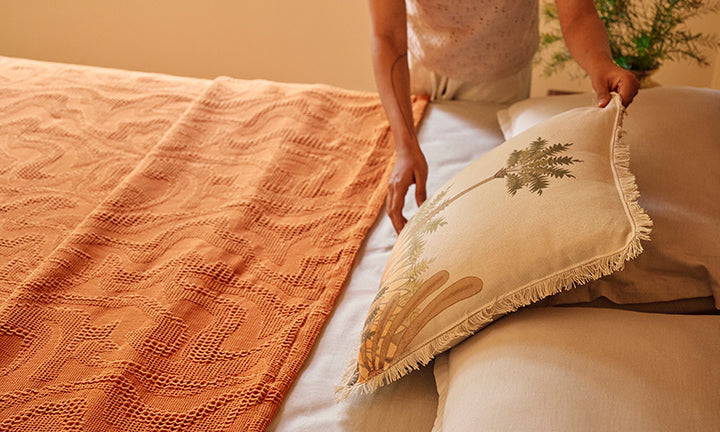
As international demand grew, so did the products. Karur became known for what the textile trade calls ‘made-ups’: finished textile articles rather than fabric sold by the metre. Bedspreads, towels, napkins, aprons, kitchen towels, bath mats, curtains, cushion covers and other household products became part of the town’s export vocabulary.
An industry grows around an industry

Perhaps the most important part of Karur’s story is what happened around the exporters.
Making a finished home textile requires far more than weaving. Yarn has to be sourced and often dyed. Fabric has to be woven, processed, cut and stitched. Finished pieces have to be checked, labelled, packed and transported.
As home-textile exports expanded, businesses specialising in those different stages expanded alongside them. The district’s export plan explicitly links export growth with the development of handloom and power-loom weaving units, dyeing and bleaching facilities, and tailoring and packaging businesses.
That is what turns a town that makes textiles into a ‘textile cluster’.
A manufacturer does not have to build every capability from the ground up because specialised knowledge and services already exist nearby. A stitching unit can work with several manufacturers. A weaving business can supply different exporters. Skills move through the local workforce, and new businesses can emerge to serve existing industries.
The scale of that ecosystem is visible today. The district’s current export plan lists about 2,972 home-textile manufacturing units in Karur, alongside more than 1,000 stitching units and a smaller number of textile-processing facilities. It estimates that home textiles and associated industries employ around one lakh people in and around Karur.
Why so many different products come from one place

Karur’s early production centred heavily on tablecloths and bedspreads. Today, the district identifies six major home-textile groups: bed linen, kitchen linen, bath linen, table linen, floor coverings and drapes.
That expansion makes sense when viewed through the lens of the manufacturing network around them. Once they have capabilities for yarn dyeing, weaving, stitching, finishing, and packing, they can apply them to many different household products.
The same loom may produce fabric destined for different uses. The same stitching expertise can move between cushion covers and table linen. The same export infrastructure can handle entirely different collections.
Karur became valuable not because it specialised in a single object, but because it developed the ability to make an entire category of home goods.
Infrastructure followed the industry's growth
The textile ecosystem also became more formalised over time.
The Government of India’s Scheme for Integrated Textile Parks developed Karur Textile Park, which began operations in 2011. The district’s current plan records 35 industries within the park, with home textiles and ready-made garments among its activities.
Karur is also connected by major road and rail routes to other textile centres in western Tamil Nadu and to larger transport networks beyond the district. The district administration highlights these connections as part of the infrastructure available to local industry.
The result is a production system that extends beyond Karur's municipal boundaries. Yarn, processing, manufacturing, packaging and transport can draw upon neighbouring textile regions as well.
Oodaii and the Karur ecosystem

Oodaii sits inside this history rather than beside it.
Its parent company, Amaravathi Textiles, was established in 1970, around the time Karur's home-textile export industry began its major expansion. Oodaii emerged later as a consumer brand built on that manufacturing experience.
The regional network remains visible in how Oodaii works today. We source yarn from certified mills close to our facility, and our processes include yarn dyeing, weaving, fabric processing, cutting, stitching, quality checking, and packing.
In that sense, an Oodaii towel or bed cover belongs to a much longer manufacturing story. The knowledge behind it is connected to a town where generations of businesses have learned how to turn yarn into finished things for the home.
Leave a comment
This site is protected by hCaptcha and the hCaptcha Privacy Policy and Terms of Service apply.