
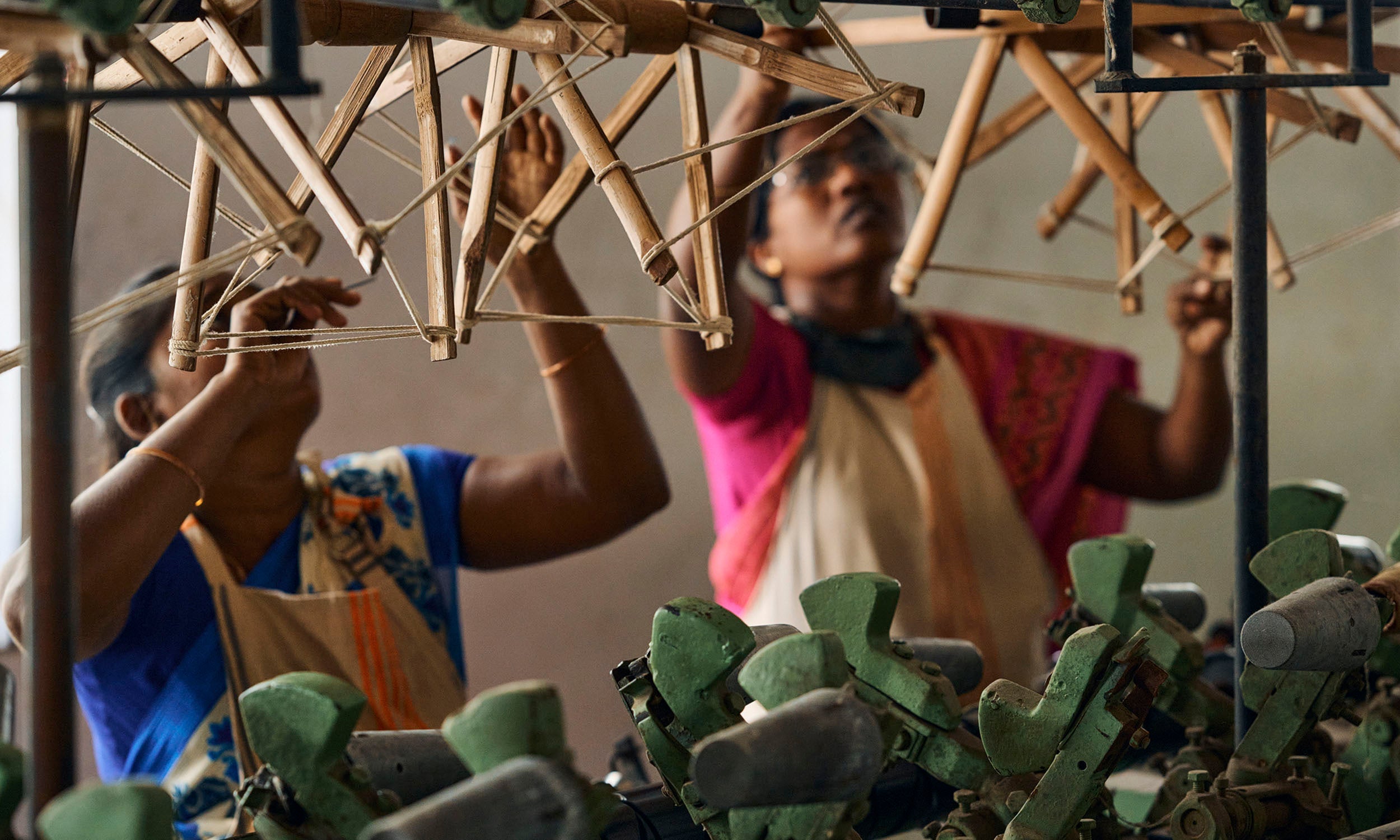
Why Hand Processes Still Matter in Textiles
We live in an age of optimisation.
Algorithms predict what we will buy, what we will watch, and how we will move through our day. Precision has become invisible and expected. Uniformity is often mistaken for excellence.
Textiles are part of this world of automation. Large mills run on calibrated systems. Dye baths are timed. Tension is measured. Output is standardised.
And yet, even in the most modern production environments, the human hand remains essential.
The Value of Slight Inconsistency

In manual weaving, threads do not behave like numbers on a screen. A shuttle moves with slight variation. Edges reveal small differences in density. To an algorithm, these are errors.
To a trained eye, they are evidence of material reality.
Slight irregularities create texture. They allow fabric to feel alive rather than flat. They prevent repetition from becoming sterile. In many heritage textiles, those small variations are part of their identity.
Even when production is mechanised, human oversight determines how much variation is acceptable and when it becomes meaningful.
Dyeing Is Not Only Chemistry

Colour charts promise consistency. Machines regulate temperature and duration. But dyeing remains deeply human.
Water quality shifts. Cotton absorbs unevenly. Climate affects drying. A decision must be made in real time: deepen the tone, reduce exposure, adjust timing. Two dye lots can follow the same formula and still require intervention.
This is where experience matters. A human eye judges whether the green is too sharp, whether the earth tone feels dull, and whether the fabric has absorbed evenly across its width. These decisions cannot be fully outsourced to automation. They rely on perceptions, memories, and judgments shaped over the years.
Precision Is Physical

Digital design tools can render patterns with flawless symmetry. But translating those patterns onto fabric introduces friction. Threads stretch. Looms have width limits. Edges must be trimmed. These physical constraints shape the outcome.
Even highly advanced production depends on human calibration. Someone must decide when a sample feels right. Someone must approve a weave structure. Someone must hold the towel and judge its weight in hand.
Heritage Is Not Opposed to Technology

It is tempting to position hand processes against machines. But in reality, textiles evolve through collaboration between both.
Mechanisation increases efficiency and scalability. It improves consistency and access. At the same time, human intervention preserves nuance. A loom can be automated; a judgment call cannot.
Heritage knowledge informs modern production. It determines where variation is acceptable and where discipline is required.
Why This Still Matters

In a world increasingly shaped by algorithms, material culture serves as a reminder that not everything meaningful can be flattened into data.
Fabric responds to pressure, moisture, temperature, and time. It ages. It softens. It shifts.
Hand processes ensure that textiles remain connected to that physical reality. They acknowledge that cloth is not a digital file. It is something that moves with us, absorbs from us, and holds memory.
At Oodaii, modern production standards coexist with respect for material behaviour. We rely on calibrated systems, but we also rely on experienced judgment. Decisions around weave, finish, colour, and weight are not left to formula alone. They are held, assessed, and refined. Because we believe our products aren’t complete without that human touch.

Leave a comment
This site is protected by hCaptcha and the hCaptcha Privacy Policy and Terms of Service apply.